
What Thread to Use for Outdoor Fabric
Thread is the cheapest thing in your build and the first thing that fails. Here is how we pick it, and it might be easier than you think.
Polyester vs Nylon Thread
Nearly every thread on our shelf is 100% polyester, and that is not an accident. It has high tensile strength, very little stretch, and it holds up to UV and moisture.
Polyester has natural resistance to UV, which can be beneficial for gear that spends a lot of time outside. It does not stretch, so seams hold their shape and topstitching stays flat. It does have slightly lower breaking strength than nylon threads of the same tex.
Nylon has slightly higher breaking strength, which is why it keeps coming up when people search for heavy duty thread. It also stretches, and it degrades in sunlight. Both are disqualifying for gear that lives outside.
Continuous filament, core spun, bonded
Two threads can both be polyester and behave completely differently.
Continuous filament is twisted from long unbroken filaments. It is the strongest construction for a given thickness and its smooth surface shrugs off abrasion. Gütermann's TERA line is continuous filament, and it is what we recommend for gear. Core spun wraps short fibres around a filament core, which grips well and handles sewing heat better but gives up a little strength. Bonded is not a separate fiber at all, it is a resin coating that locks the twist so the thread will not fray through the needle eye. If your thread keeps shredding at the eye on heavy work, a bonded thread usually fixes it outright, before you start adjusting tension.
Reading Tex, and why the numbers look backwards
Tex is the weight in grams of 1,000 metres of thread. If 1,000 m weighs 40 g, it is Tex 40. Higher number, thicker thread. That is the entire system, and it is linear, so Tex 70 really is twice the mass per metre of Tex 35.
The confusing part is that Gütermann's own product numbers run the other way. TERA 40 is heavier than TERA 80. Same with MARA.
| Gütermann | Tex | Use |
|---|---|---|
| TERA 80 | Tex 35 | Light packs, pouches, shelters |
| MARA 70 | Tex 40 | General bag work, 15 colours |
| MARA 50 | Tex 60 | Heavier seams, 5 colours |
| TERA 40 | Tex 70 | Heavier seams |
If a listing anywhere gives you a ticket number instead of a Tex, ticket numbers also run inversely. Ask for the Tex.
Needles
The needle is the step people skip, and it causes more problems than any other single choice. Its job is not only to pierce the fabric. It carries the thread through and opens a hole big enough for the thread to pass without friction. Too small and the thread abrades on every stitch until it snaps. Too large and you are punching holes bigger than the seam needs, which weakens light fabric and lets water through coated ones.
Needles carry two numbers printed together, like 90/14. The first is European, the second American. Same needle, two systems, and both go up as the needle gets thicker. Pick one and ignore the other. The sizes on the chart above are the ones to use.
Point type matters as much as size on our fabrics:
- Universal is the default and is fine for most wovens, Cordura and canvas.
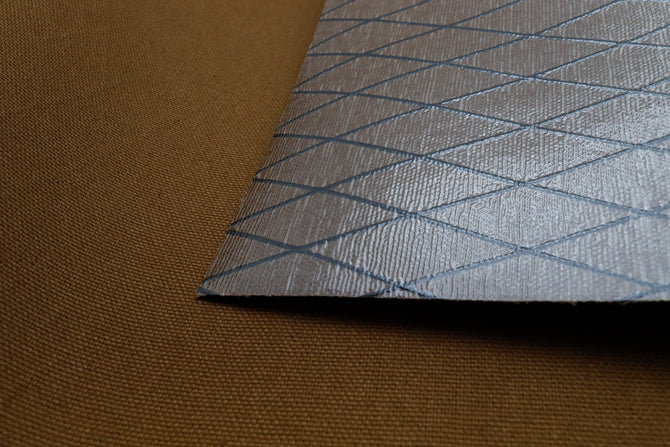
- Microtex has a slim, acute point that makes the smallest, cleanest hole. Use it on anything coated or laminated: technical laminates, silpoly, X-Pac, Ultra.
- Denim has a reinforced blade that resists deflection through thick tightly woven material. Use it on canvas, 1000D and webbing stacks.
- Ballpoint pushes between knit loops rather than cutting them. Use it on mesh, stretch and fleece.
On waterproof laminates, a Microtex needle plus a slightly longer stitch is the single best thing you can do for seam integrity. You are perforating a membrane on every stitch, so fewer and smaller holes beats more and larger ones.

How much thread a build actually uses
More than you'd think. A lockstitch pulls from the needle and the bobbin and loops around itself at every stitch, so you burn about three times your seam length.
The garment industry plans at 2.5x. We round up, because pack seams are thicker than shirt seams and ply count is the thing that really drives consumption. A strap anchor is webbing over binding over face fabric over reinforcement. That eats thread.
Add up the seams on your pattern, multiply by three, add ten percent for the bits you unpick.
Which means a 400 m TERA 40 cone is about 130 m of finished seam. A 6,000 m Poly Plus 40 cone is closer to 2,000 m.
What your stitches are telling you
| Symptom | Usual cause | Try first |
|---|---|---|
| Top thread keeps breaking | Needle eye too small for the thread | Go up one needle size, fit a fresh needle |
| Skipped stitches | Blunt needle or wrong point type | New needle, Microtex on anything coated |
| Loops or nesting underneath | Top thread not seated in the tension discs | Rethread completely with the presser foot up |
| Puckered seams | Thread too heavy, or stitch too short | Drop one weight and lengthen the stitch |
| Needle deflecting or snapping | Needle too light for the material stack | Denim needle, slow down, stop pulling the fabric |
| Thread fraying at the eye | Unbonded thread at speed, or a burr in the path | Try a bonded thread, check for rough spots |
| Coating damaged around stitches | Needle larger than it needs to be | Drop a size, switch to Microtex |
| Seam opens under load | Thread stretching, or the wrong stitch pattern | Polyester not nylon, box stitch the load points |
Common questions
What thread should I use for outdoor fabric?
Continuous filament polyester, sized to the fabric. Tex 35 to 45 for ripstop and light packs, Tex 60 to 70 for heavy seams.
Is nylon or polyester thread better for outdoor use?
Polyester. Nylon has marginally higher breaking strength but it stretches, and it degrades in sunlight fast enough to matter. Polyester holds up far better in UV and stays dimensionally stable under load, so the seam stays tight. It is not immune to sun either, which is why marine work reaches for PTFE, but for packs, bags and shelters it is the right call.
What needle size do I use with polyester thread?
It follows the thread weight, not the fibre. Tex 35 takes a 70 to 90, Tex 45 takes a 90, Tex 60 takes a 90 to 100, and Tex 70 takes a 100 to 110.
Why is TERA 40 thicker than TERA 80?
Gütermann's product numbers run inversely to thread weight. The product number multiplied by the Tex stays roughly constant, so a higher number means a finer thread. TERA 80 is Tex 35 and TERA 40 is Tex 70.
Can my home sewing machine handle heavy thread?
Most modern domestics are fine to about Tex 45, and many will run Tex 70 in the needle with a lighter bobbin thread and a 100 or 110 needle. Above Tex 70 you generally want a walking foot or an industrial machine.
Do I need a cone stand?
For anything above roughly 800 metres, yes. The larger cones will not fit a domestic spool pin. A stand is inexpensive and it also improves feed on the smaller cones.
What is outdoor thread?
It is not a formal category, just shorthand for thread that survives sun and weather. In practice that means UV stable polyester, usually in a heavier Tex than dressmaking thread.
Does polyester thread shrink?
Barely. It is dimensionally stable, which is part of why it is preferred for gear. Cotton and cotton wrapped threads shrink noticeably and will pucker seams after washing.
Can I use serger thread for structural seams?
No. Serger thread is built to be light and fast rather than strong, and it will not hold a loaded seam in a pack.
Is Gütermann thread good?
Yes. It is consistent cone to cone and the published specs are honest, which matters when you are matching needle sizes. The TERA line is the continuous filament option meant for gear.
Where to start
If you are new to this and want one thread that handles most of what you will build, get MARA 70 in a colour you like, or Poly Plus 40 if you would rather have 6,000 metres for the same money and can live with a cone stand.
If you are already building and want to stop thinking about thread cost, buy a Tex 70 and a Tex 45 deadstock cone and you are set for years.
Not sure which pairing suits your build? Send us the fabric and the project and we will tell you what we would use. Browse all thread or start with the fabric.